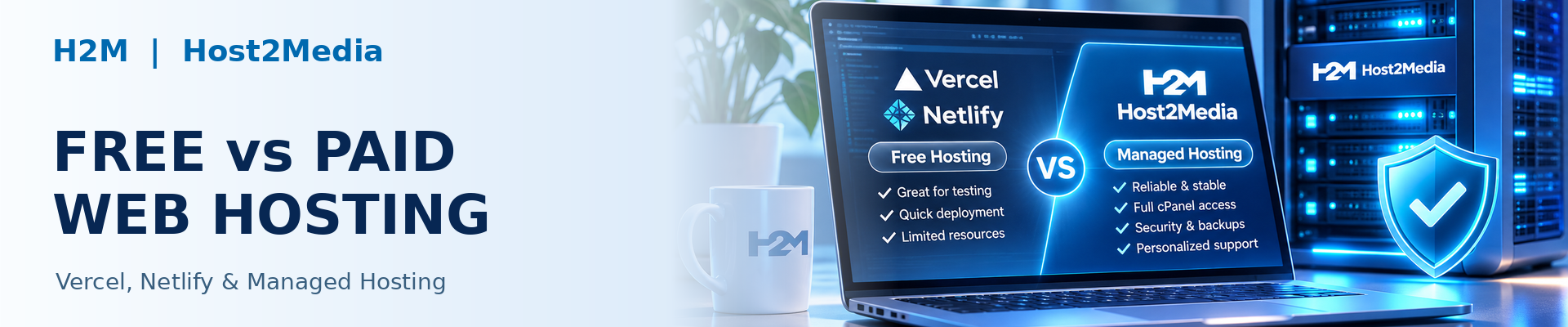
Free vs Paid Web Hosting in 2026: Is Vercel or Netlify Enough for Your Business?
Posted on: November 1, 2026
by: Nadim Younes, Founder | Business Strategist
Building a website has never been easier.
With modern development frameworks, AI website builders, and deployment platforms such as Vercel and Netlify, almost anyone can create and publish a website without purchasing traditional web hosting.
In many cases, it costs absolutely nothing to get started.
But there is an important distinction between publishing a website for free and operating a reliable website for a business.
Free hosting platforms provide valuable opportunities for developers, students, entrepreneurs, and anyone experimenting with new ideas. However, once a website becomes part of a company’s daily operations, the requirements can change significantly.
So when is free hosting enough, and when should you consider paid managed web hosting?
What Is Free Web Hosting?
Free web hosting generally refers to services that allow users to publish websites or applications without paying an initial subscription fee.
Modern platforms such as Vercel and Netlify have made deployment remarkably convenient.
Developers can connect a Git repository, publish a project, receive automatic HTTPS certificates, and deploy updates directly from their development workflow.
These platforms are particularly attractive for static websites, modern JavaScript frameworks, portfolio projects, and experimental applications.
And unlike some traditional free hosting services, they can offer sophisticated infrastructure, content delivery networks, and integrated development tools.
However, free plans come with specific usage limits, eligibility rules, and service restrictions.
Understanding those conditions is essential before placing an important business website on one.
Vercel: Free Hosting With Important Conditions
Vercel is widely used for deploying modern web applications, particularly those built with Next.js and other JavaScript frameworks.
Its free Hobby plan provides automatic deployments, HTTPS, a global CDN, and access to supported serverless functionality.
For personal projects and experimentation, it can be an excellent option.
However, according to Vercel’s official pricing information, the Hobby plan is intended for personal, non-commercial use.
Businesses and professional commercial projects should evaluate its paid plans.
Vercel Pro starts at $20 per month and introduces additional capabilities, collaboration tools, and usage-based billing.
This does not mean Vercel is unsuitable for business websites.
Quite the opposite: its paid services support serious production applications.
The important consideration is that a free development plan should not automatically be treated as a permanent commercial hosting solution.
Netlify: A Different Approach to Free Hosting
Netlify provides a similar developer-friendly deployment experience, supporting static websites, modern frameworks, functions, databases, and other application services.
Its free plan supports custom domains, SSL certificates, and deployment workflows.
However, Netlify uses a credit-based usage model.
As of November 2026, its free plan includes 300 credits per month. Credits are consumed by activities such as production deployments, bandwidth, requests, and compute usage.
When the account reaches its monthly credit limit, its projects can become paused until the next billing cycle or until the account is upgraded.
According to Netlify’s documentation, paused projects stop serving normal website traffic.
For a personal experiment, that may be an acceptable trade-off.
For a company relying on its website to receive customer inquiries, reservations, or online orders, an unexpected interruption could create a business problem.
Netlify also provides paid plans designed for increased usage and operational requirements.
The lesson is not that Netlify is unreliable.
It is that the free tier has boundaries that businesses must understand.
Free Hosting Does Not Mean Unlimited Resources
One of the most common misunderstandings surrounding free hosting is the assumption that a website will continue running under any level of demand.
In practice, resources must be allocated and paid for somewhere.
Hosting platforms may establish limits on bandwidth, compute execution, build activity, requests, storage, or other usage.
When those limits are reached, the consequences depend on the provider and the selected plan.
A free service may pause workloads, restrict further usage, or require an upgrade.
A paid platform may instead charge for additional consumption, depending on its billing configuration.
Traditional managed hosting plans also have resource limits. Paid hosting is not automatically unlimited, nor does paying a subscription guarantee that a website can absorb any traffic spike.
The real advantage comes from understanding what resources are included, what happens when limits are reached, and who is responsible for managing the service.
The Hidden Responsibility of Managing a Website
Publishing a website is only one step in running it.
A business website may also require domain management, professional email, backups, security maintenance, databases, application updates, technical troubleshooting, and recovery procedures.
These responsibilities do not disappear simply because the website was deployed successfully.
Modern deployment platforms can provide many of these capabilities through built-in features, integrations, or additional services.
However, customers must determine which tools they need, how those tools work together, and who will support them when something goes wrong.
Managed hosting takes a different approach.
Rather than concentrating exclusively on deployment, it brings website infrastructure and technical assistance together as a service.
For businesses without an internal technical team, this can be an important distinction.
What About AI-Generated Websites and Applications?
Artificial intelligence has introduced a new generation of website creators.
Someone with limited programming experience can now use AI tools to generate a responsive website, build application features, or develop a prototype.
This is an exciting development.
But generating code and operating a secure production application are two different activities.
An AI-generated website may require server-side execution, environmental configuration, databases, scheduled tasks, authentication, secure storage, or integrations with external services.
Some applications are well suited to Vercel or Netlify.
Others may benefit from traditional hosting environments, managed virtual servers, or specialized application infrastructure.
The correct choice depends on the application’s actual requirements.
For example, a static website generated by AI may work perfectly well on a free deployment platform.
A PHP application requiring MySQL, persistent file storage, and traditional server configuration may be better suited to compatible managed hosting.
Applications requiring long-running processes, containers, or specialized runtimes may need a VPS or another suitable hosting architecture.
There is no universal hosting environment for every AI-generated application.
Understanding compatibility before deployment is more important than choosing a provider based solely on price.
What Does Paid Managed Hosting Provide?
A professionally managed hosting service may include infrastructure resources, website management tools, technical support, security services, backup capabilities, and assistance with migrations or configuration.
The scope varies significantly by provider and plan.
At Host2Media, our approach focuses on premium, personalized managed hosting rather than competing exclusively on the lowest advertised price.
We believe a hosting service should be evaluated by the quality of its infrastructure, the attention devoted to its operation, and the support available when customers need assistance.
Our hosting environments are designed to support established website technologies while evolving to accommodate modern development requirements.
We also recognize that newer applications may require different deployment models.
That is why choosing suitable infrastructure begins with understanding the application rather than forcing every project into the same hosting package.
Free Hosting vs Paid Managed Hosting: A Practical Comparison
| Consideration | Free Deployment Platforms | Paid Managed Hosting |
|---|---|---|
| Initial cost | Often $0 | Subscription or annual fee |
| Website deployment | Frequently Git-based and automated | Control panel, migration, or provider-assisted |
| Resource limits | Defined free-tier quotas | Defined plan allocations |
| Commercial use | Depends on provider terms | Generally supported |
| Professional email | May require a separate service | Often available with hosting plans |
| Server-level controls | Platform-specific | Depends on hosting product |
| Backups | Vary by feature and service | Vary by provider and plan |
| Technical support | Usually limited by free-tier terms | Depends on managed service agreement |
| Ideal use | Learning, prototypes, personal projects | Business sites and supported production workloads |
Neither model is universally superior.
The appropriate choice depends on the website’s importance, technical requirements, budget, and the responsibilities its owner is prepared to manage.
When Should You Choose Free Hosting?
Free hosting can be an excellent choice when learning web development, building a portfolio, publishing a small personal website, experimenting with AI-generated code, or testing an application concept.
If your project fits the platform’s technical model, complies with its terms, and remains comfortably within its resource limits, there may be no immediate reason to pay for hosting.
When Should You Consider Paid Hosting?
Paid hosting becomes worth considering when your website supports commercial operations, generates customer inquiries, processes important business activity, or requires resources and services not adequately covered by a free plan.
It can also be useful when you prefer direct technical assistance rather than managing multiple infrastructure services independently.
The deciding factor should not be whether a website can technically run for free.
It should be whether the hosting arrangement meets the operational needs of the project.
Conclusion: Your Website May Be Free, but Your Business Depends on It
Free hosting platforms have helped make the web more accessible, and their contribution to modern development should not be underestimated.
They allow ideas to be tested, applications to be demonstrated, and new developers to publish their work with remarkably little friction.
But as a website becomes more important, the questions change.
What happens when traffic grows? Who responds when something breaks? How are backups managed? Is the application compatible with its hosting environment? What happens when resource limits are reached?
These are the questions that separate a successful deployment from a sustainable hosting strategy.
At Host2Media, we believe reliable managed hosting is about more than keeping a website accessible.
It is about combining suitable infrastructure with professional attention, security, and personalized service.
A website can be free to publish. Keeping it dependable is a responsibility worth planning for.
References
-

share
-

-

-

More similar topics
Claude AI Developed a Remote Root Exploit for a Critical Linux Kernel Vulnerability As cPanel and WHMCS Prices Keep Rising, Host2Media Is Building a Different Future Managed Web Hosting in Lebanon: Why Personalized Support Still Matters AI Can Build Your Website. Who Is Securing It? Your Website Has a Backup. But Can You Actually Restore It?
Professional infrastructure. Personal service.
Copyright © 2026 Host2Media. All rights reserved.