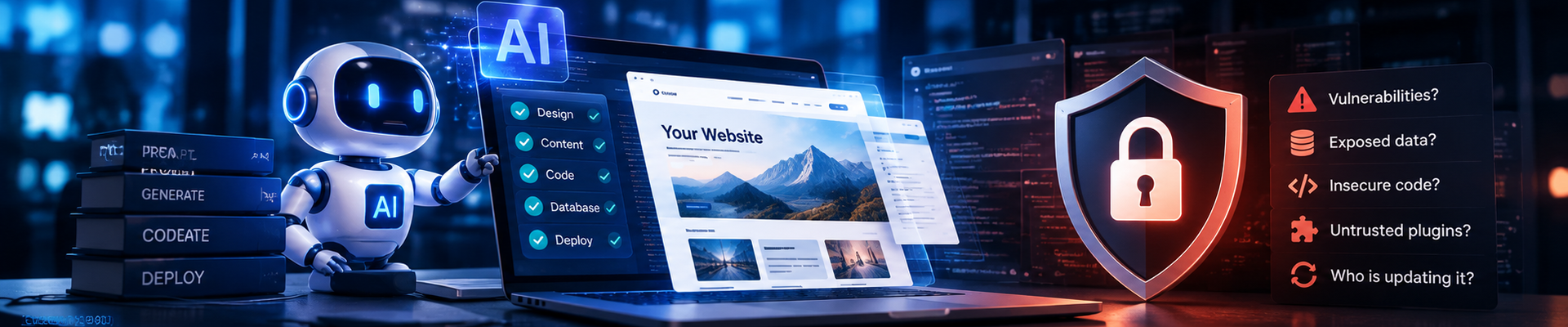
AI Can Build Your Website. Who Is Securing It?
Posted on: October 28, 2026
by: Nadim Younes, Founder | Business Strategist
A business owner describes an idea.
An AI coding assistant generates the website. A few prompts later, there is a contact form, an admin dashboard, a database, and perhaps even a payment integration.
What once required weeks of development can sometimes be prototyped in hours.
The website looks finished.
It loads correctly. The buttons work. The design is responsive.
So the owner uploads it to a hosting server and announces the launch.
There is just one uncomfortable question.
Who checked whether the application is secure?
Working Code Is Not Necessarily Secure Code
AI-generated code can be useful, productive, and surprisingly sophisticated.
But generating functional software and verifying its security are different tasks.
An application might perform perfectly during ordinary testing while containing vulnerabilities that remain invisible to the person using it.
Examples include:
- Missing authorization checks that allow users to access another customer’s information.
- Database queries vulnerable to SQL injection.
- Forms that fail to validate or safely handle submitted data.
- Exposed API keys or database credentials.
- Insecure file uploads.
- Dependencies containing known vulnerabilities.
These problems are not exclusive to AI-generated applications. Human developers introduce them too.
The difference is that AI has made creating and deploying software accessible to far more people, including those without a background in application security.
The Hosting Server Cannot Fix Every Application Vulnerability
A properly maintained hosting environment is an essential security layer.
Server updates, access isolation, malware detection, firewalls, and sensible configuration help reduce infrastructure-related risks.
However, hosting security and application security are not interchangeable.
If a website allows an ordinary user to access another customer’s private records because of a missing authorization check, a secure server configuration does not automatically correct that application logic.
Likewise, a firewall cannot guarantee that an application has implemented its authentication, session handling, and business rules correctly.
A secure hosting environment protects the infrastructure. Secure application design protects the logic and data inside it. Both matter.
AI-Generated Dependencies Need Special Attention
Modern web applications often depend on external libraries, frameworks, and packages.
AI coding assistants may suggest packages that are outdated, unsuitable, or even nonexistent.
Developers should verify dependencies, use trusted package sources, check for known vulnerabilities, and keep components maintained.
This is particularly important when AI tools can execute installation commands and modify project files.
The OWASP Secure Coding with AI guidance explicitly addresses risks including vulnerable dependencies, excessive agent permissions, and AI-generated tests that provide misleading confidence.
Before Publishing an AI-Built Website
Whether the application was generated by an AI assistant or developed traditionally, several questions deserve clear answers.
Authentication: Are passwords handled securely? Are sessions protected? Are privileged operations restricted to authorized users?
Data protection: Are database credentials and API keys stored securely? Is sensitive information protected from unauthorized access?
Input handling: Does the application validate input and safely handle database queries, uploads, and displayed content?
Dependencies: Are third-party packages reviewed and maintained?
Error handling: Does the application avoid exposing sensitive debugging information to visitors?
Recovery: Is there a backup and restoration strategy appropriate for the application?
Deployment: Does the selected hosting environment support the application’s actual runtime, required services, and resource needs?
A successful deployment should answer these questions before real customer data enters the system.
Not Every AI Application Needs the Same Hosting
A static website generated with AI may need little more than a compatible web server.
A PHP application connected to a database has different requirements.
An application that depends on a persistent Node.js process, background workers, WebSockets, or specialized services requires a hosting environment that explicitly supports those components.
The label “AI-generated” does not determine hosting compatibility.
The application’s actual architecture does.
Choosing hosting based on runtime requirements is far more reliable than choosing it based on how the code was produced.
The Future of Web Development Still Needs Responsibility
AI is changing how software is created.
It lowers barriers, accelerates prototypes, and makes experimentation possible for people who previously had limited access to development resources.
That is meaningful progress.
But the responsibility for security has not disappeared. It has simply become easier to overlook.
Before launching an AI-generated application, treat it as production software.
Review it. Test it. Secure it. Maintain it.
And remember:
AI can generate the code. It cannot remove the responsibility that comes with publishing it.
Host2Media supports businesses and developers who value carefully managed hosting environments and direct technical communication. Application compatibility and security requirements should always be reviewed before deployment.
Explore Host2Media: https://host2media.com/
-

share
-

-

-

More similar topics
Managed Web Hosting in Lebanon: Why Personalized Support Still Matters Your Website Has a Backup. But Can You Actually Restore It? Managed Web Hosting in Lebanon: Why Businesses Choose Host2Media ASP.NET vs. AI-Generated Websites: Is Windows Hosting Still Necessary? Cloud Infrastructure in 2026: Major Acquisitions, Security, AI, and the Future of Web Hosting
Professional infrastructure. Personal service.
Copyright © 2026 Host2Media. All rights reserved.