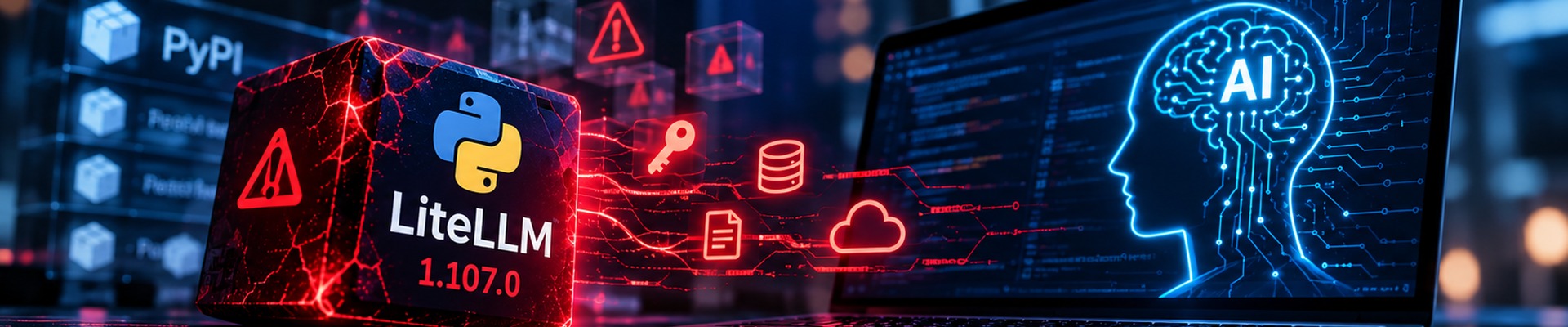
Your AI Application Could Be Compromised Before It Even Starts
Posted on: October 24, 2026
by: Nadim Younes, Founder | Business Strategist
The latest LiteLLM supply-chain attack reveals a growing danger in modern software development: even trusted dependencies can become an entry point for cybercriminals.
A New Warning for the AI Industry
Artificial intelligence is transforming how businesses build websites, automate operations, and develop applications. But as AI adoption accelerates, so does the complexity of securing the infrastructure behind it.
On October 21, 2026, LiteLLM, a widely used open-source framework that helps developers connect applications to different AI models, disclosed a serious security incident involving its software release infrastructure.
Attackers compromised the release process and distributed malicious software through official package and container distribution channels.
The compromised LiteLLM version 1.107.0 contained malware designed to steal credentials and enable unauthorized remote access.
For developers and businesses relying on AI technologies, the incident raises a critical question:
How secure is an application when the software it depends on can no longer be trusted?
What Happened to LiteLLM?
LiteLLM is commonly used as a gateway between applications and AI services, simplifying access to different language models through a unified interface.
Its popularity makes it a valuable target for attackers.
According to published incident reports, the October 21 compromise involved unauthorized access to LiteLLM’s software release pipeline.
Attackers managed to distribute malicious artifacts through the Python Package Index (PyPI) and container registries.
The affected release included credential-stealing malware and remote-access capabilities.
This type of attack is known as a software supply-chain attack.
Instead of attacking individual websites directly, cybercriminals compromise software that developers already trust.
The consequences can extend beyond a single application, potentially exposing API credentials, cloud environments, databases, and other connected services.
Why This Attack Matters Beyond AI
The most concerning aspect of a supply-chain attack is that malicious software can enter an environment through an otherwise legitimate development or deployment process.
A developer might install a dependency from an official repository, believing it to be trustworthy.
An automated deployment pipeline might retrieve a compromised container image.
A production application might inherit a vulnerable dependency without the business owner ever realizing it.
In each scenario, the attack begins within a process that normally supports application development.
This highlights an increasingly important cybersecurity principle:
A trusted source does not guarantee that every software release is trustworthy.
The risks are particularly serious when applications have access to sensitive credentials, production databases, or cloud infrastructure.
What Businesses and Developers Should Learn
The LiteLLM incident reinforces several important security practices.
1. Verify software dependencies
Applications should use approved dependency versions and reproducible deployment processes. Unexpected package changes deserve investigation before production deployment.
2. Protect credentials and API keys
Sensitive credentials should never be unnecessarily exposed to application processes. Access should be limited according to operational requirements, with secrets rotated when compromise is suspected.
3. Maintain infrastructure isolation
Separating applications, accounts, and services can help reduce the impact of security incidents and limit unauthorized access.
4. Monitor security advisories
Security vulnerabilities and compromised software releases can emerge unexpectedly. Keeping track of official advisories allows technical teams to evaluate risks and respond appropriately.
5. Prepare for incident recovery
Reliable backups, documented recovery procedures, and tested restoration processes are essential components of business continuity.
Security is not only about preventing an incident. It is also about limiting its consequences.
The Host2Media Approach: Infrastructure That Evolves With Emerging Threats
At Host2Media, we understand that web hosting is no longer simply about providing disk space, bandwidth, and an online server.
Modern businesses require hosting environments that are actively maintained, monitored, and supported by professionals who understand the evolving cybersecurity landscape.
Our managed hosting infrastructure incorporates established security technologies, including:
- CloudLinux: Resource management and account-level isolation capabilities.
- CageFS: Isolation between hosting accounts to help reduce cross-account exposure.
- Imunify360: Layered server security, malware detection, and protection capabilities.
- Cloudflare: DNS, network-edge security, and traffic protection capabilities.
- Managed infrastructure maintenance: Ongoing server administration, security updates, and operational oversight.
We follow developments across the cybersecurity and web hosting industries to assess emerging threats and determine appropriate protective measures.
While no hosting provider can guarantee absolute protection against every vulnerability or compromised software dependency, maintaining a layered security strategy can significantly improve an organization’s ability to manage risk.
Importantly, infrastructure security and application security must work together.
A protected hosting environment does not eliminate the need for developers to maintain secure code, verify third-party packages, and safeguard application credentials.
Security is a shared responsibility, and effective protection requires attention at every layer.
The Future of Hosting Is About More Than Performance
The rapid adoption of AI-generated websites, automated development tools, and increasingly complex applications is changing the hosting industry.
Businesses are deploying new technologies faster than ever before.
But faster development should not mean weaker security.
A modern hosting provider must understand that the infrastructure supporting an application is part of its overall security architecture.
At Host2Media, our focus remains on delivering professionally managed hosting solutions built around reliability, infrastructure maintenance, and layered security.
Because staying online is important.
Staying prepared for what comes next is equally important.
Host2Media | Managed Web Hosting & Infrastructure Security
Whether your business operates a corporate website, an e-commerce platform, or a custom web application, choosing the right hosting environment is an important part of building a reliable digital presence.
Host2Media provides managed web hosting solutions backed by professional infrastructure administration and multiple layers of security.
Discover our hosting solutions: https://host2media.com
Host2Media. Your business deserves more than a place to host its website.
-

share
-

-

-

More similar topics
PHP2Shell: The Critical PHP Exploit That Sent the Internet Into Emergency Mode When the Cloud Goes Down, Does Your Business Go Down With It? Stop Roasting Your Laptop: Why Closing the Lid Doesn’t Turn It Off (And Other PC Sins) Honoring Labor Day: A Salute to Every Worker The Anatomy of a Secure Website: Essential Features Every Business NeedsCopyright © 2024, Host2Media,